What did this study actually measure?
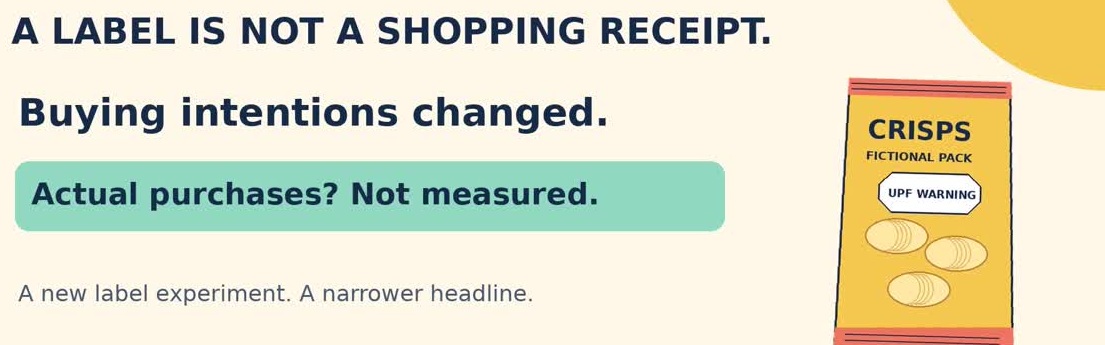
A warning label changed what people said they might buy. It did not record what went into their shopping baskets. That is the difference between saying you will go to the gym and counting who walks through the turnstile.
The new paper asks a useful, specific question: does adding an ultra-processed food (UPF) warning change responses when nutrient warnings may already be on the packet? It does not test whether every processed food is dangerous, or whether a sticker prevents disease. The crisps have acquired another label, not a medical degree.
What did the researchers actually do?
Aline D’Angelo Campos and colleagues published the study in Frontiers in Nutrition on 2 November 2026. Participants were recruited in July–August 2025. A publication date and a data-collection date are different things. Neither is a record of observed supermarket shopping here.
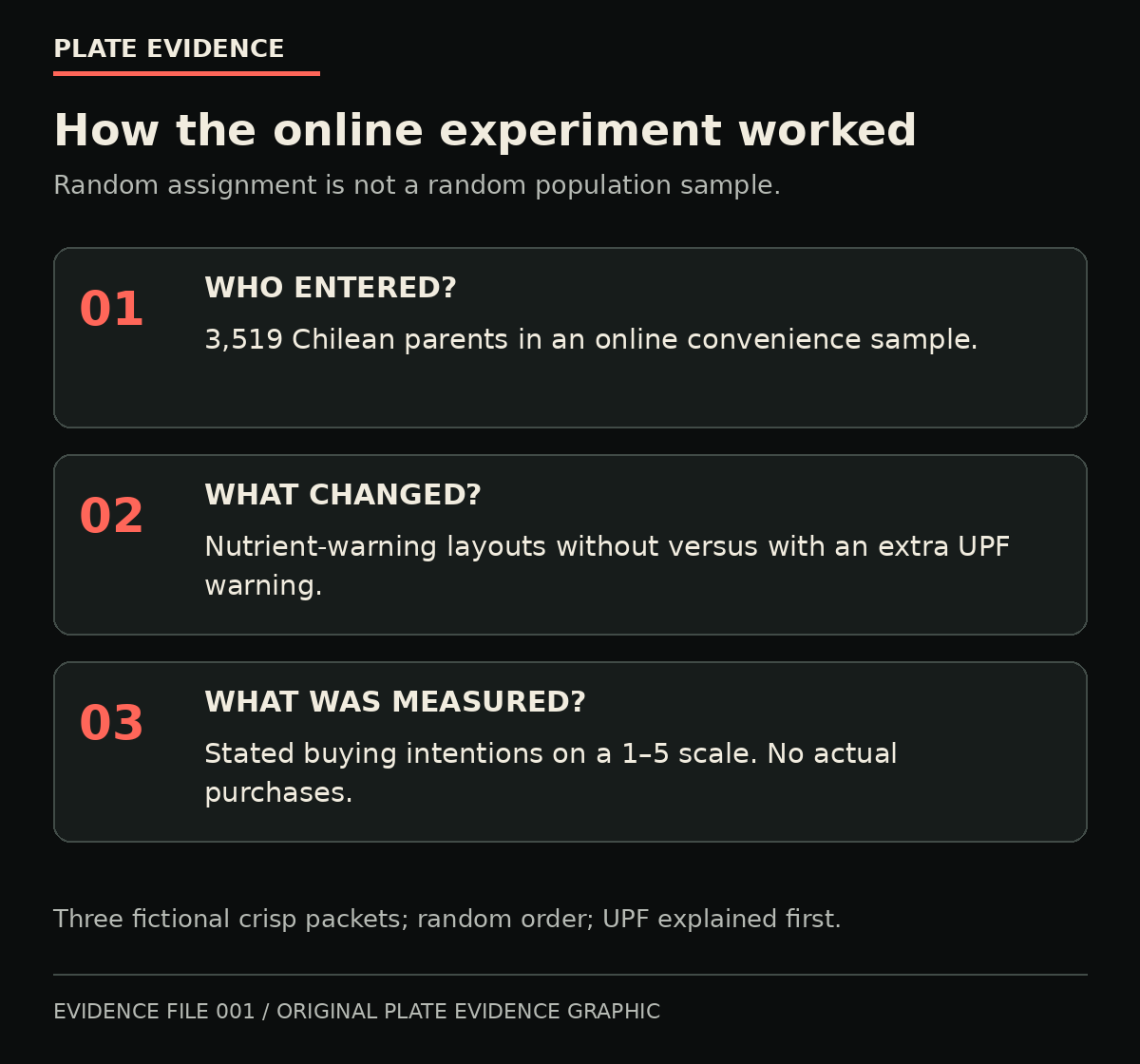
The analysis included 3,519 Chilean parents, with a mean age of 39.6 years. They came from an online convenience sample — a group who were easy to reach online, not a random sample of the entire population. They were, however, randomly assigned to the experimental conditions. Recruitment decides who enters the room. Random assignment decides which version they see. The latter strengthens comparisons within the experiment. It does not make the sample representative of everyone, everywhere.
Participants viewed three fictional sour-cream-and-onion crisp packets. All three were classified as ultra-processed. One had no nutrient warning; one had a high-sodium warning; the third had high-sodium and high-saturated-fat warnings. No nutrient warning did not mean “unprocessed”.
The experimental condition added a white octagonal UPF warning to distinguish it from the existing black nutrient warnings. The control condition retained the nutrient-warning arrangement without that extra warning. Product order was randomised.
Before the task, participants received an explanation of “ultra-processed”. The researchers intended this to resemble a rollout accompanied by public education. It was not a test of an unexplained sticker appearing overnight.
What changed — and what was not measured?
People rated how likely they would be to buy each product in the next week if it were available in a store, on a 1–5 buying-intention scale. A questionnaire does not have a checkout, however confidently we click the button.
| Existing nutrient warnings | Change in intention score | 95% confidence interval |
|---|---|---|
| None | −0.32 points | −0.41 to −0.23 |
| One: high sodium | −0.23 points | −0.31 to −0.14 |
| Two: high sodium + saturated fat | −0.20 points | −0.29 to −0.11 |
Source: paper, Table 2. n = 3,519; all three comparisons p < 0.001. These are signed point differences on the 1–5 scale — not percentages, money, calories or units sold.
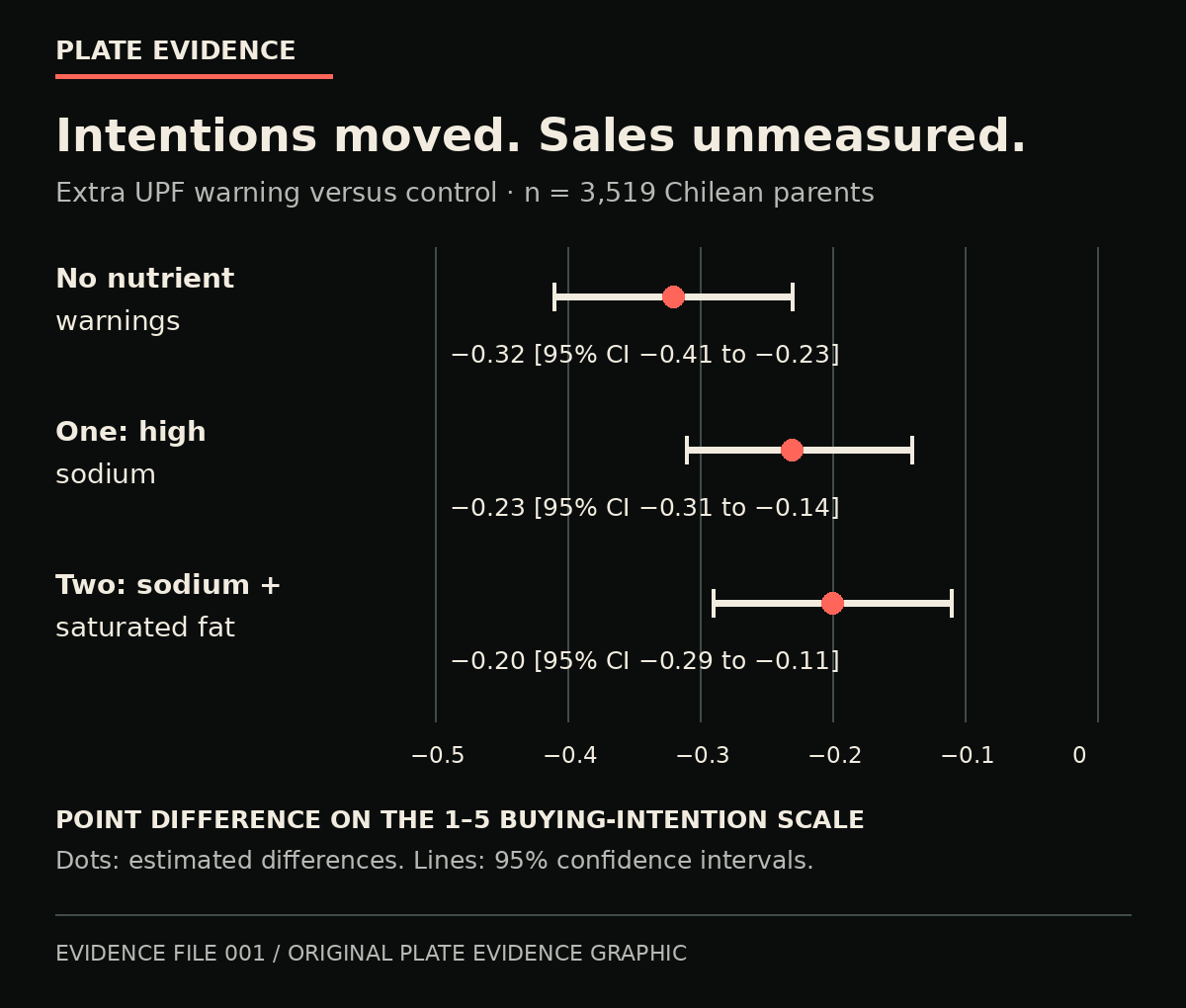
A 95% confidence interval is the analysis’s range of uncertainty around an estimate. Here the intervals describe statistical uncertainty around the estimated differences under the analysis, not the spread of individual answers or every possible source of bias.
The largest reduction appeared for the packet without nutrient warnings. Direct model comparisons supported a larger effect there than for either packet with nutrient warnings. The difference between the one-warning and two-warning products was not statistically significant. Different-looking numbers are not automatically established differences.
The authors discuss possible explanations: an extra warning may have less room to shift perceptions when warnings are already present, or people may respond partly to the number of warnings. Those are interpretations, not measurements of the machinery inside anyone’s head.
What else changed?
The extra warning improved correct UPF identification for the zero-warning and one-warning products; the improvement for the two-warning product was not statistically significant. Perceived healthfulness fell for all three products. Neither outcome is a measured improvement in anyone’s health. “Perceived” is a small word doing an actual job.
Where does the conclusion have to stop?
- No actual purchases were measured. Neither were food intake or subsequent health outcomes.
- One food category. Crisps are not the entire food supply wearing a crunchy disguise. The same effect sizes cannot simply be assigned to drinks, breakfast foods or ready meals.
- A particular sample and setting. Chilean parents in an online convenience sample are not every population or shopping context.
- The explanation was part of the task. We cannot assume an unexplained warning would have the same effect.
- Packets differed slightly. Colours, names and imagery varied as well as nutrient warnings. The paper acknowledges that these differences may contribute to between-product differences.
A shopper might dislike a warning and still buy the product because of price, habit or availability. That is a hypothetical example, not an observed result. This experiment cannot tell us how often it happens.
None of these limits makes the experiment worthless. Random allocation is a real strength for studying responses in this task. Good criticism keeps that useful result and draws a boundary around it; it does not throw the study in the nearest bin for failing to be every study at once.
Who funded the study?
The paper names Bloomberg Philanthropies and additional supporting funding. The authors report that funders had no role in design, execution, interpretation or writing, and declare no commercial or financial relationships that could be construed as a potential conflict of interest. Those are the authors’ disclosures, not our independent audit.
What is the Plate Evidence verdict?
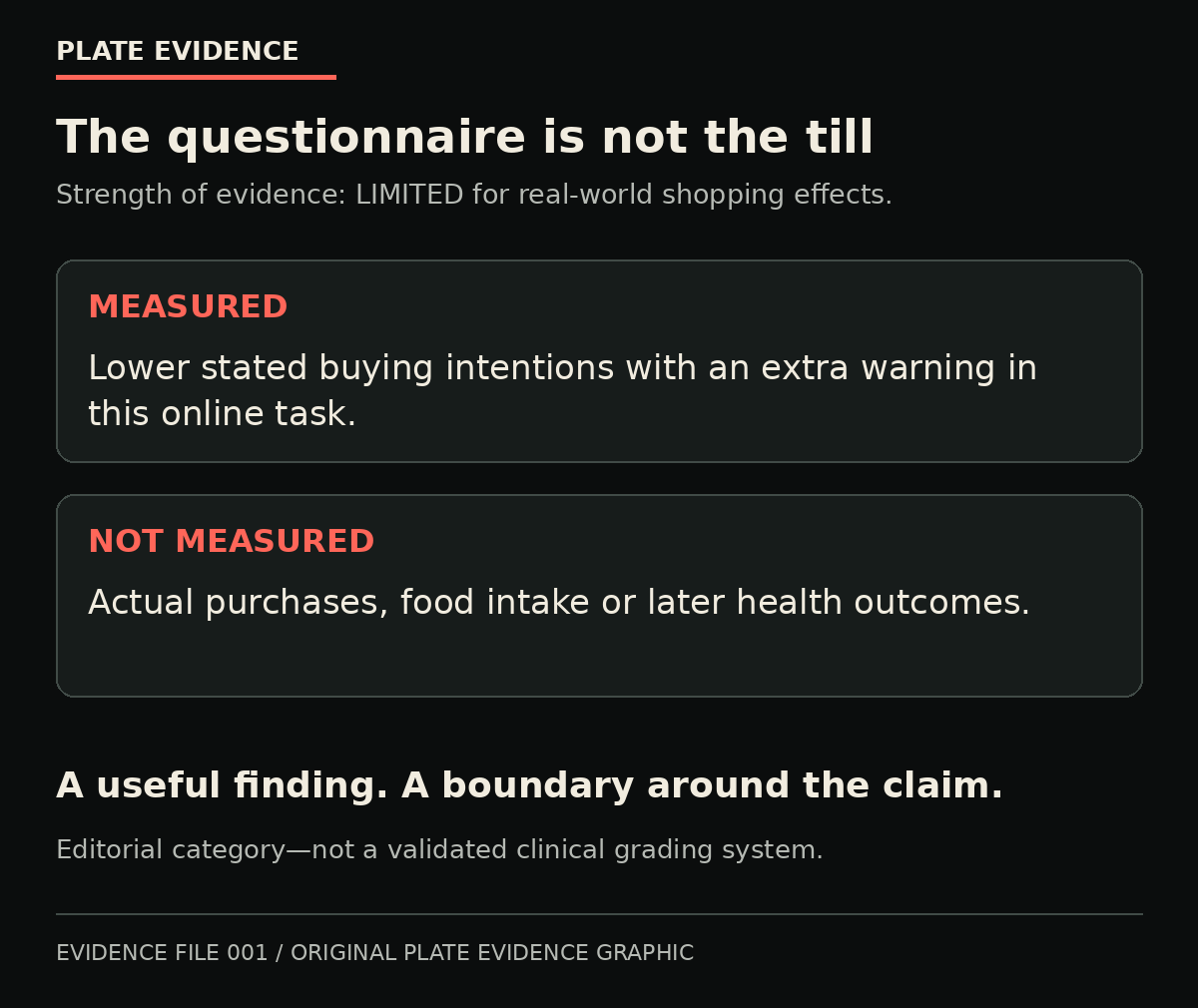
An extra UPF warning lowered stated buying-intention scores and changed product perceptions in this online experiment. Its largest buying-intention effect appeared on the packet without nutrient warnings. Whether this translates into actual purchases remains an open question. Both halves belong in the same sentence.
Evidence observing actual purchases under clearly compared label conditions, across more foods and populations, and over time would move us closer to real-world shopping effects. Those are suggestions for the next research step, not predictions of what it would find.
Try the headline test
- Name the people studied.
- Name what changed.
- Name what was actually measured.
- Check what the headline quietly added.
If a paper measures intentions and the headline announces a collapse in sales, the headline has gone shopping without the researchers.
Questions from the label desk
Did the warning labels cut sales?
No. The study measured what 3,519 Chilean parents said they might buy, on a 1 to 5 intention score, not what they actually bought. A supermarket receipt was not among the outcomes.
What exactly was measured?
An online experiment with fictional crisp packets. Participants were an online convenience sample of Chilean parents, randomly assigned to conditions. The paper was published in Frontiers in Nutrition on 2 November 2026.
Who funded the study?
The paper names Bloomberg Philanthropies and additional supporting funding. The authors report that funders had no role in the work, and declare no relevant commercial conflicts. Those are the authors’ disclosures, not an independent audit.
Is this a new UK law?
No. It is a Chilean online experiment on buying intentions. It is not a UK labelling rule, and it does not tell us what would happen in a British supermarket.
Watch the Plate Evidence investigation
This Film 1 investigation is now public on @PlateEvidence. The written article, primary source and caveats stand on their own.
Watch on YouTube ↗Primary source
D’Angelo Campos A, Smith Taillie L, Hall MG, Ng SW and Rebolledo N. Front-of-package ultraprocessed warning labels: a randomized controlled trial with Chilean parents. Frontiers in Nutrition 13:1973978. Published 2 November 2026.
Read the open-access paper ↗ · DOI: 10.3389/fnut.2026.1973978
Research commentary, not personalised medical or legal advice. This article does not prescribe a diet or announce a new law.