Is Red 40 actually banned?
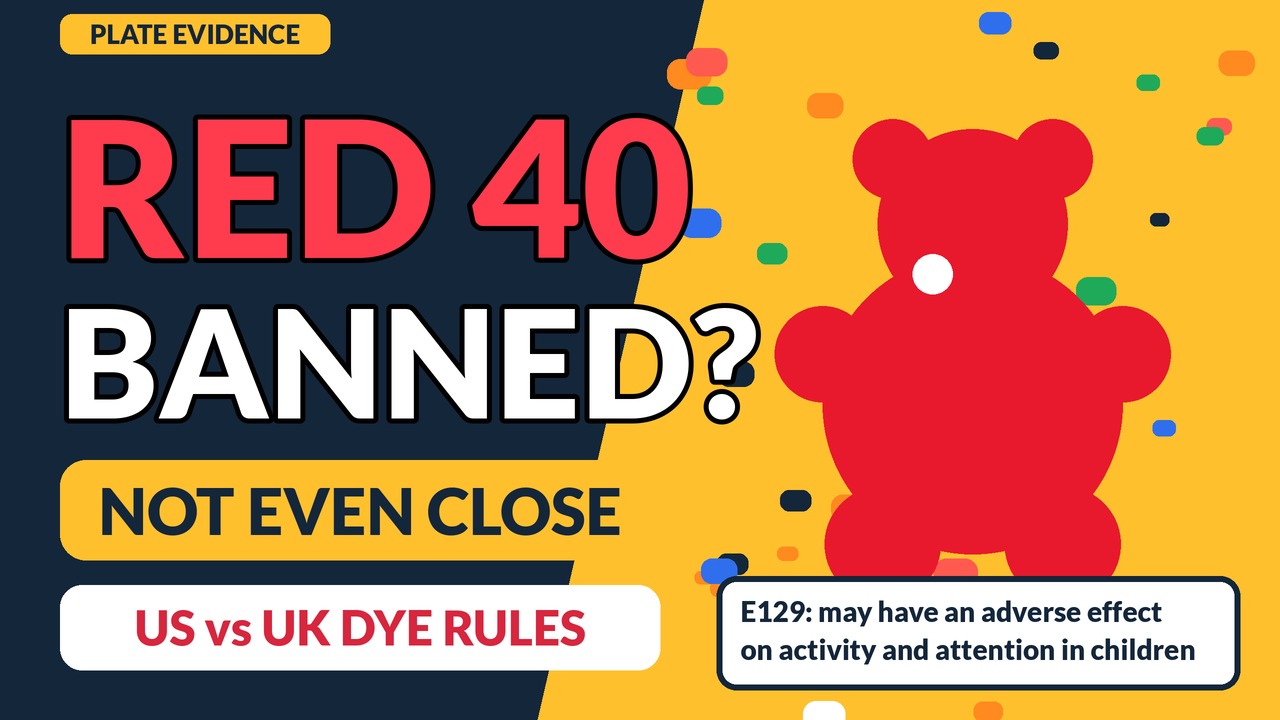
Social posts say Red 40 has been banned. It has not. The useful distinction is between an order, a proposal and a request.
What is an order, a proposal and a request?
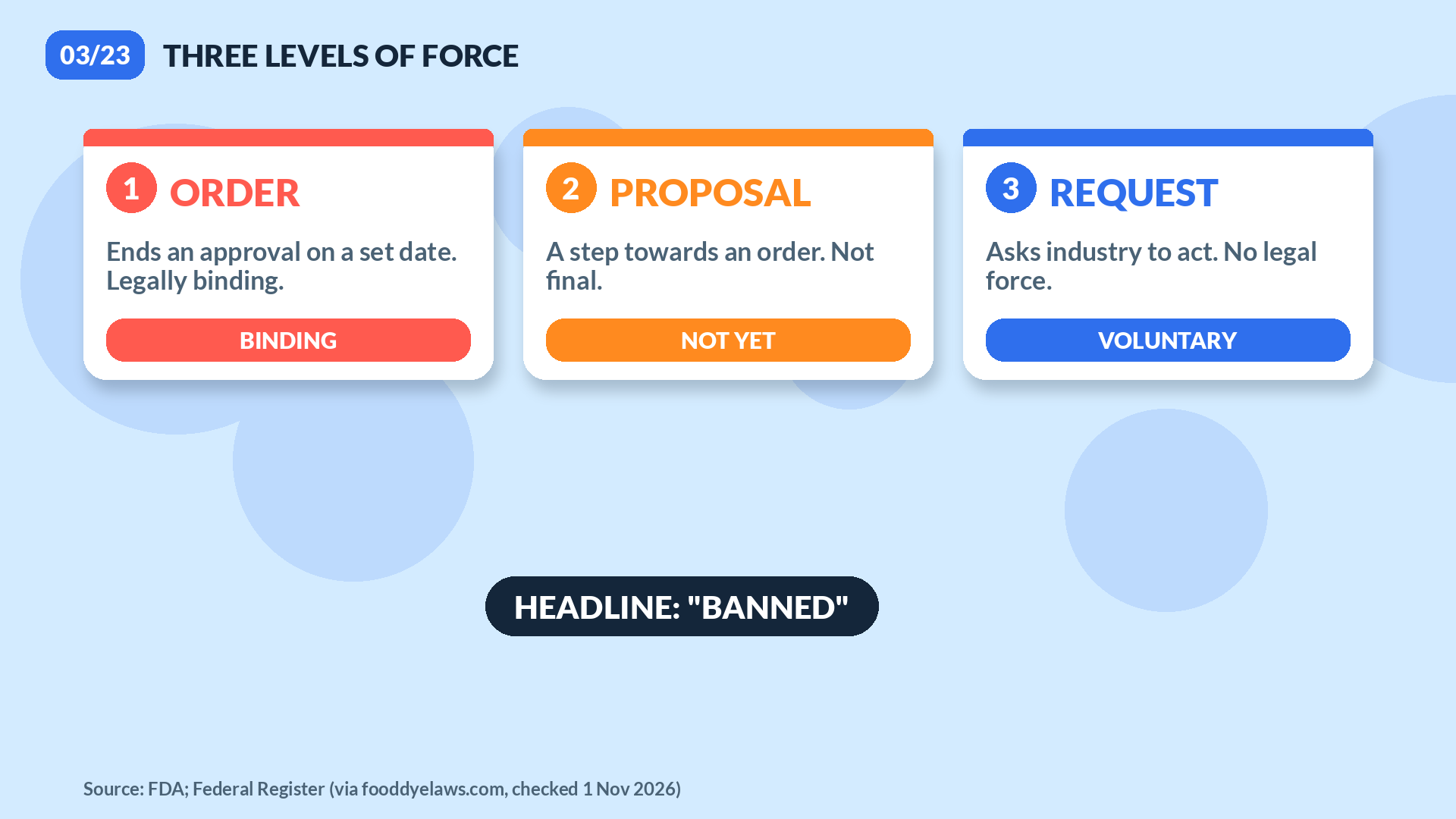
In US food law an order ends an approval on a set date and binds everyone — the court judgement. A proposal is a step towards an order; it can change, stall or die. A request has no legal force — a polite letter, not a lock on the door.
| Action | What it does | Binding? |
|---|---|---|
| Order | Ends an approval on a set date | Yes |
| Proposal | A step towards an order; can still change | Not yet |
| Request | Asks industry to act | No |
Which dyes are actually banned in the US?
- Brominated vegetable oil (BVO): authorisation revoked from 2 August 2024 (89 FR 55040).
- Orange B: revoked from 8 September 2026 as abandoned (91 FR 46276).
- Red 3 (erythrosine): revoked for food from 15 January 2027 and for ingested drugs from 18 January 2028 (90 FR 4628). The FDA lifted its stay on the order on 5 August 2026 (91 FR 50475).
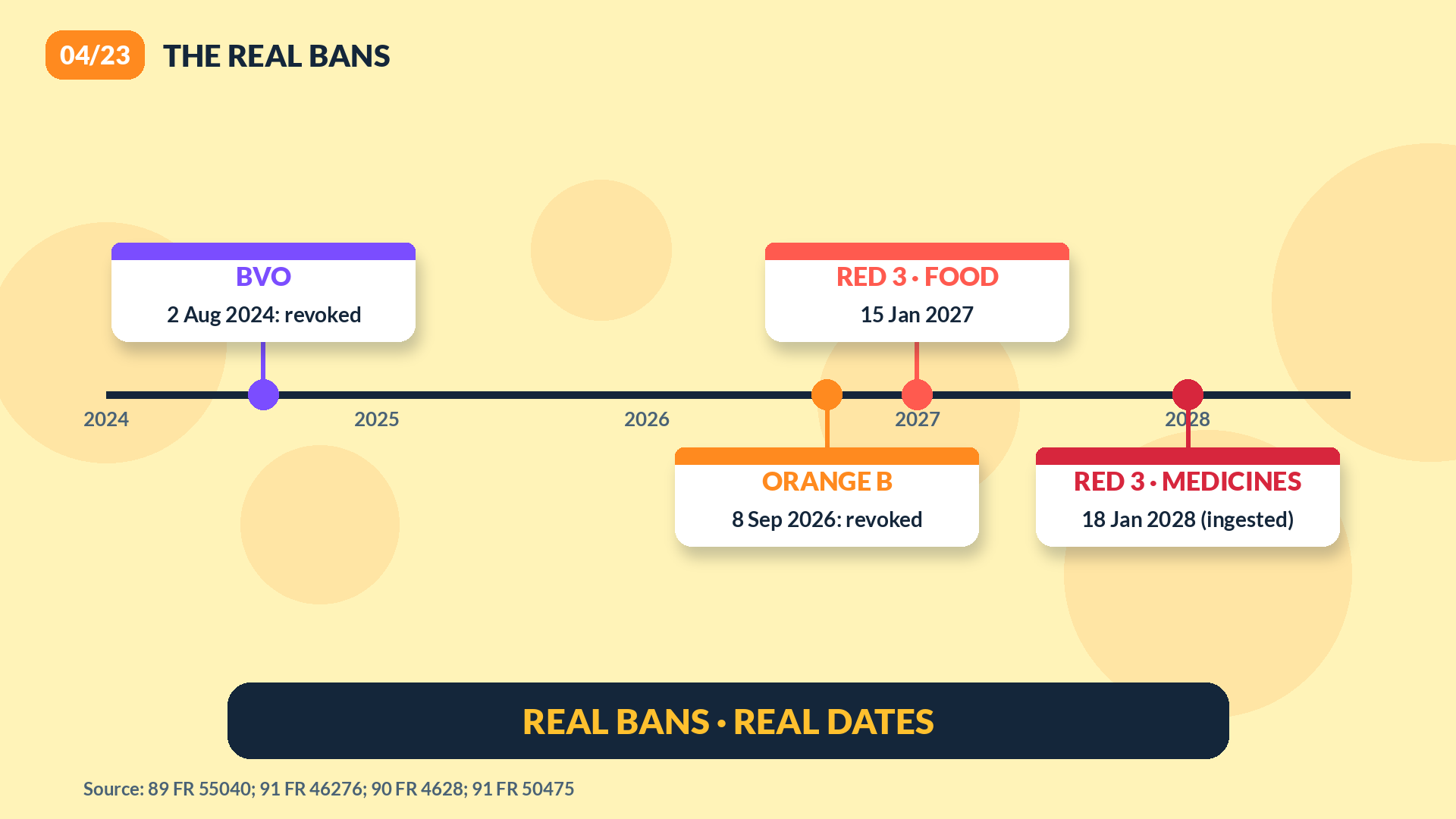
Red 3 did not fall because of children’s behaviour. The Delaney Clause bars any colour additive found to induce cancer in humans or animals. The evidence was in male rats, and the FDA itself said the rat mechanism does not occur in humans. It is a ban by statute, not a verdict that Red 3 harms people.
On 23 July 2026 the FDA proposed revoking Citrus Red 2, permitted only on the skins of some oranges (91 FR 46330). Comments closed on 24 August 2026; no final order had been issued by 1 November 2026. It remains legal. A proposal is a ban the way a job interview is a salary.
Where does Red 40 actually sit?
On 22 April 2025 HHS and the FDA asked industry to eliminate Red 40, Yellow 5, Yellow 6, Blue 1, Blue 2 and Green 3. The original target was the end of 2026; the FDA’s tracker now points to the end of 2027. All six remain approved. Red 40 is still listed at 21 CFR 74.340.
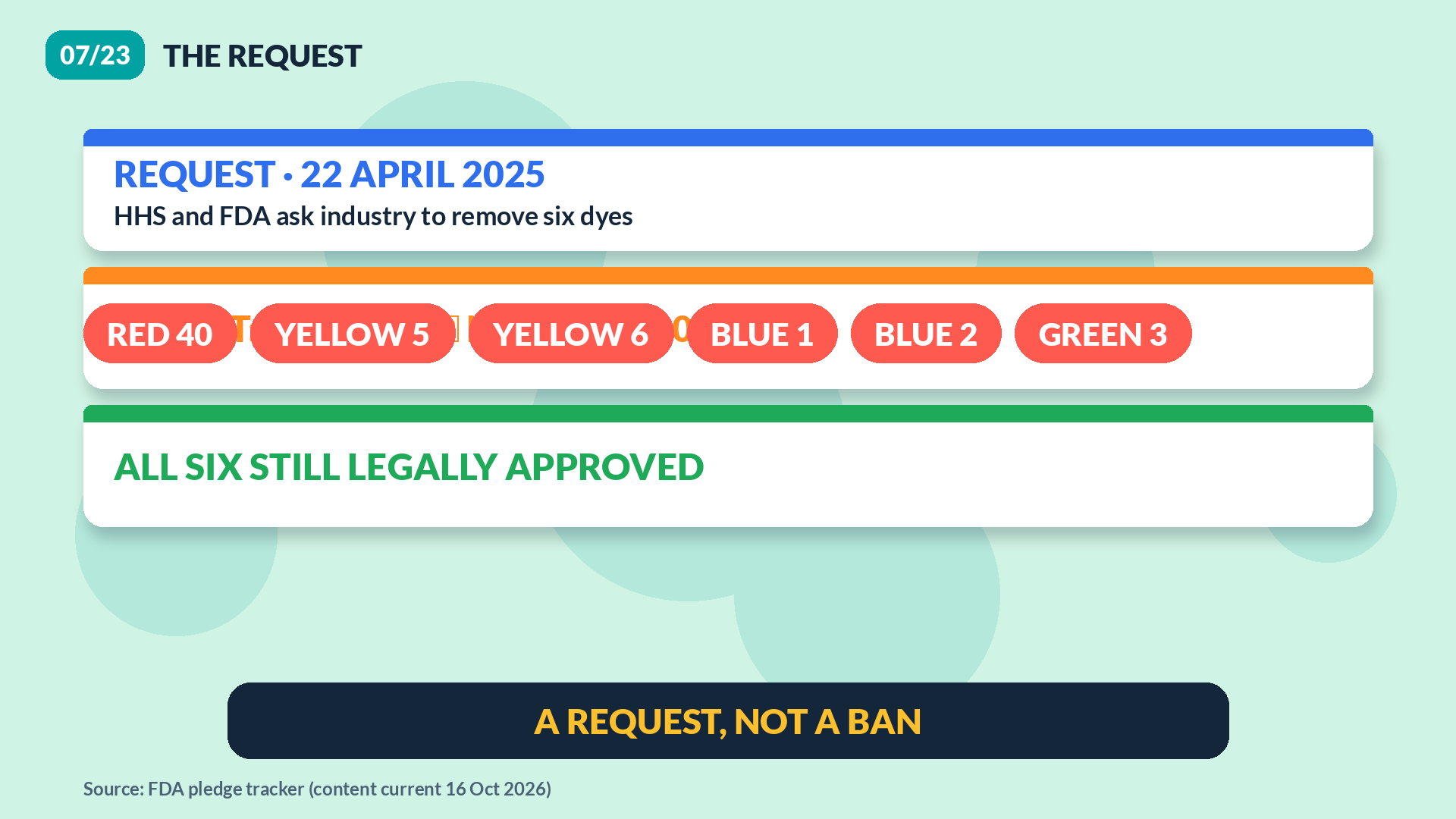
The FDA’s pledge tracker listed 32 company and trade-group entries in mid-October 2026, including General Mills (US cereals and K-12 school foods by summer 2026) and Nestlé (US portfolio by mid-2026). A pledge is a press release, not an inspection. The proof is the ingredient list.
On 29 October 2026 Rep. Nancy Mace introduced H.R. 10936, the Eliminating Dangerous Color Additives Act. It would deem every batch-certified synthetic dye (and its lakes) unsafe in food, drugs, devices and cosmetics two years after enactment. As introduced it has one named sponsor, sits with the House Energy and Commerce Committee, and is not law. Several US states restrict dyes in school food — a canteen rule, not a nationwide shop ban on Red 40.
Is Red 40 banned in Britain or the EU?
Red 40 is Allura Red AC, E129 in Europe — the same dye with a different passport. It is approved in Britain and the EU, not banned. The difference is what the packet has to say about it.
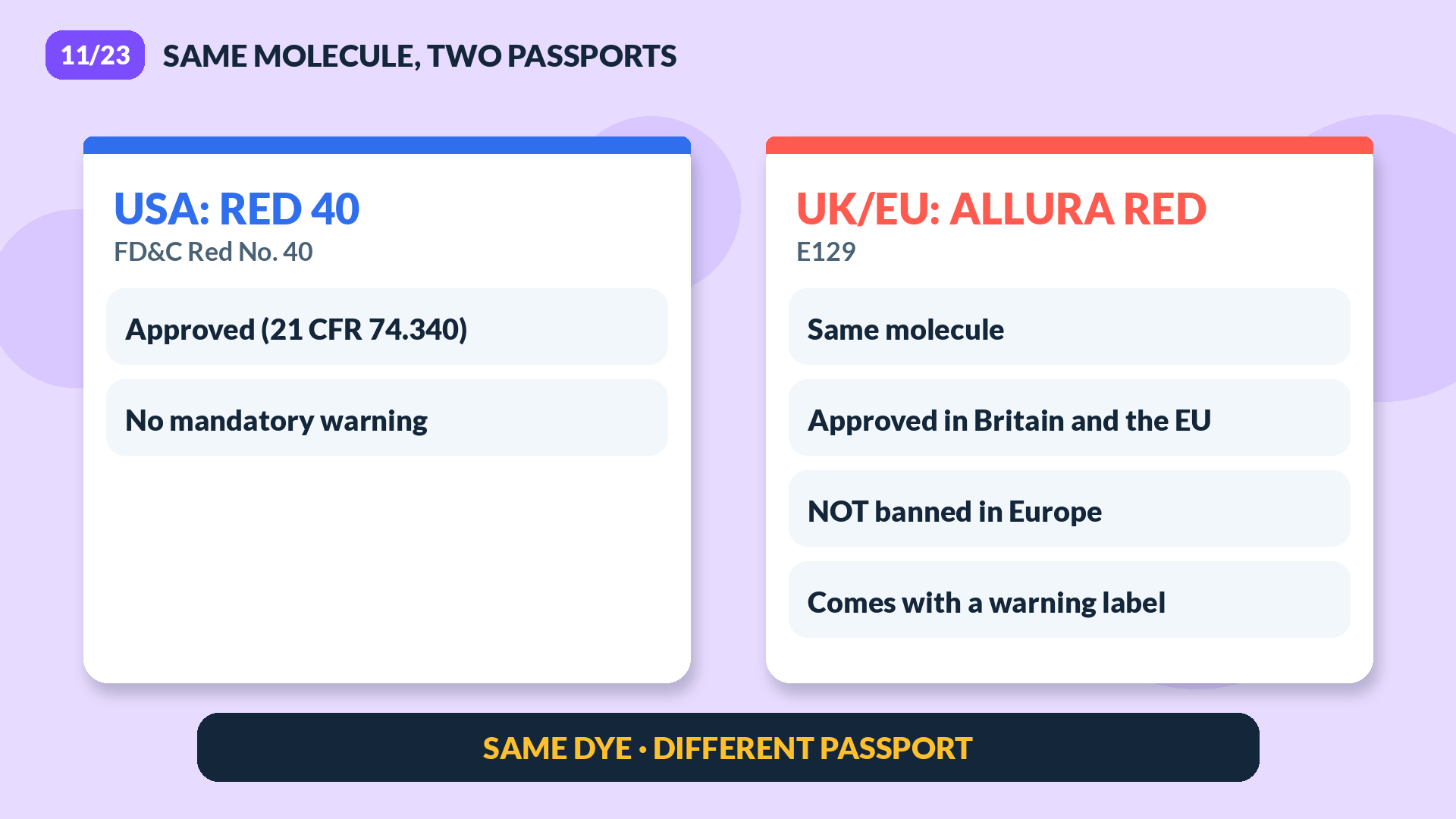
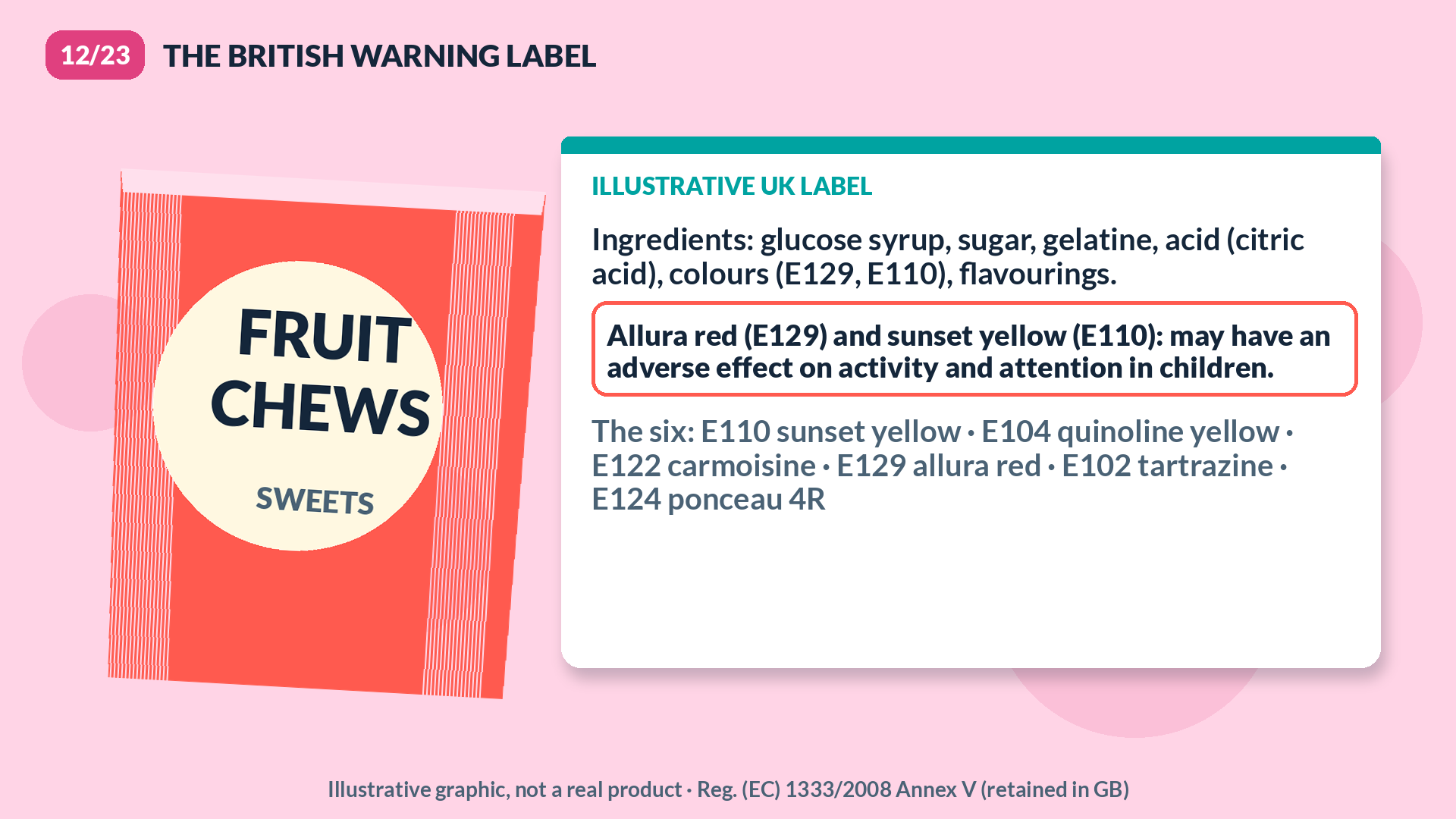
Since 20 July 2010, foods containing any of six colours — E110 sunset yellow, E104 quinoline yellow, E122 carmoisine, E129 allura red, E102 tartrazine and E124 ponceau 4R — must carry the warning: “[name or E number of the colour(s)]: may have an adverse effect on activity and attention in children.” That is Annex V of Regulation (EC) No 1333/2008, retained in Great Britain.
What did the Southampton study actually show?
That warning traces back largely to one trial. McCann and colleagues (The Lancet, 2007; funded by the Food Standards Agency) tested colour mixtures plus sodium benzoate against placebo. Average hyperactivity scores rose slightly with the mixtures.
| Feature | Detail |
|---|---|
| Children | About 300: 153 aged 3, 144 aged 8–9 |
| Design | Randomised, double-blind, placebo-controlled crossover |
| Tested | Two colour mixtures, each with sodium benzoate, against placebo |
| Outcome | Hyperactivity scores — not an ADHD diagnosis |
| Result | Small average increases with the mixtures |
The catch: mixtures, not single dyes. Mix B (sunset yellow, carmoisine, quinoline yellow and allura red) raised hyperactivity scores in the 8–9-year-olds but not the 3-year-olds, according to EFSA. No effect can be pinned on one dye.
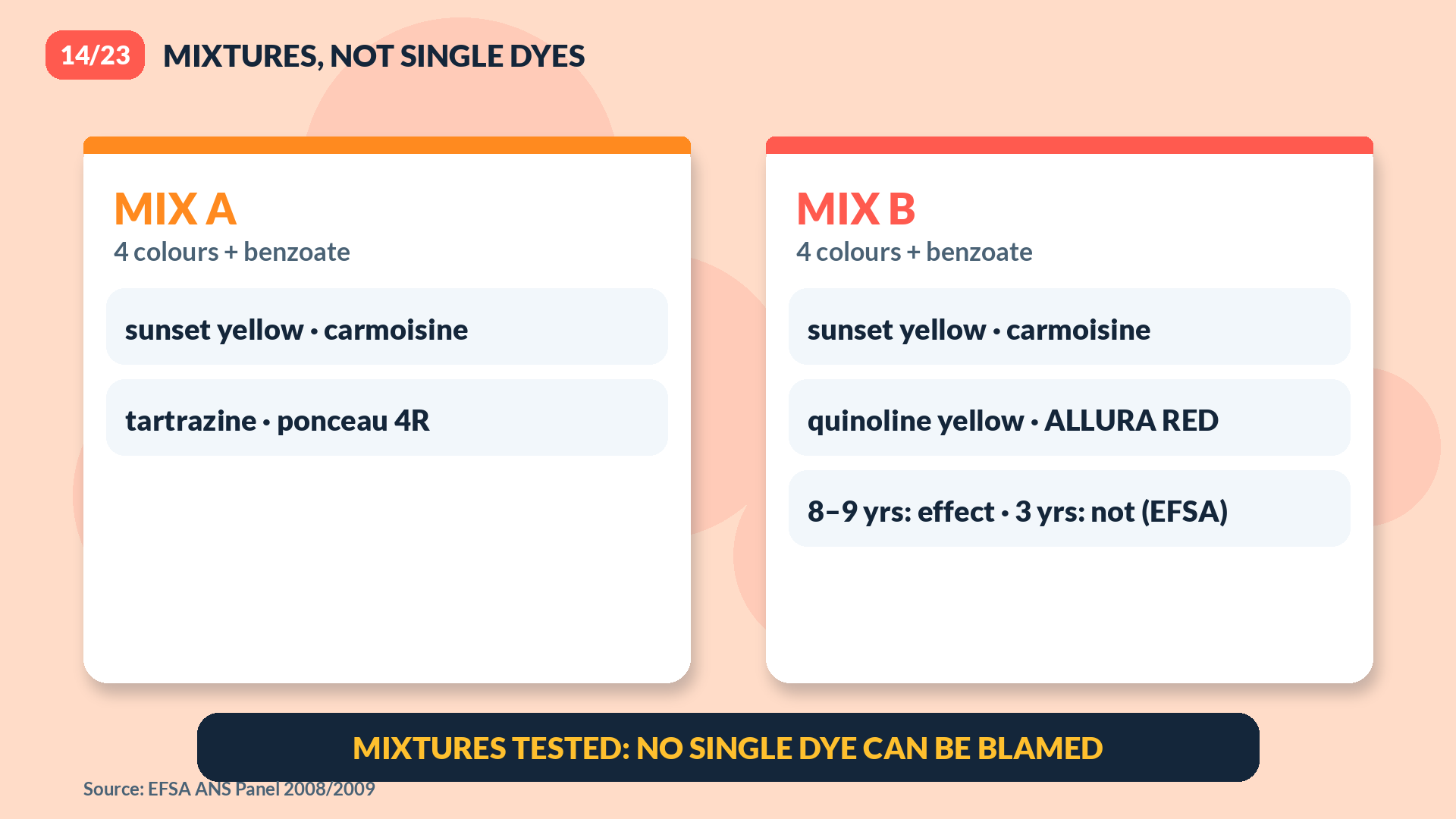
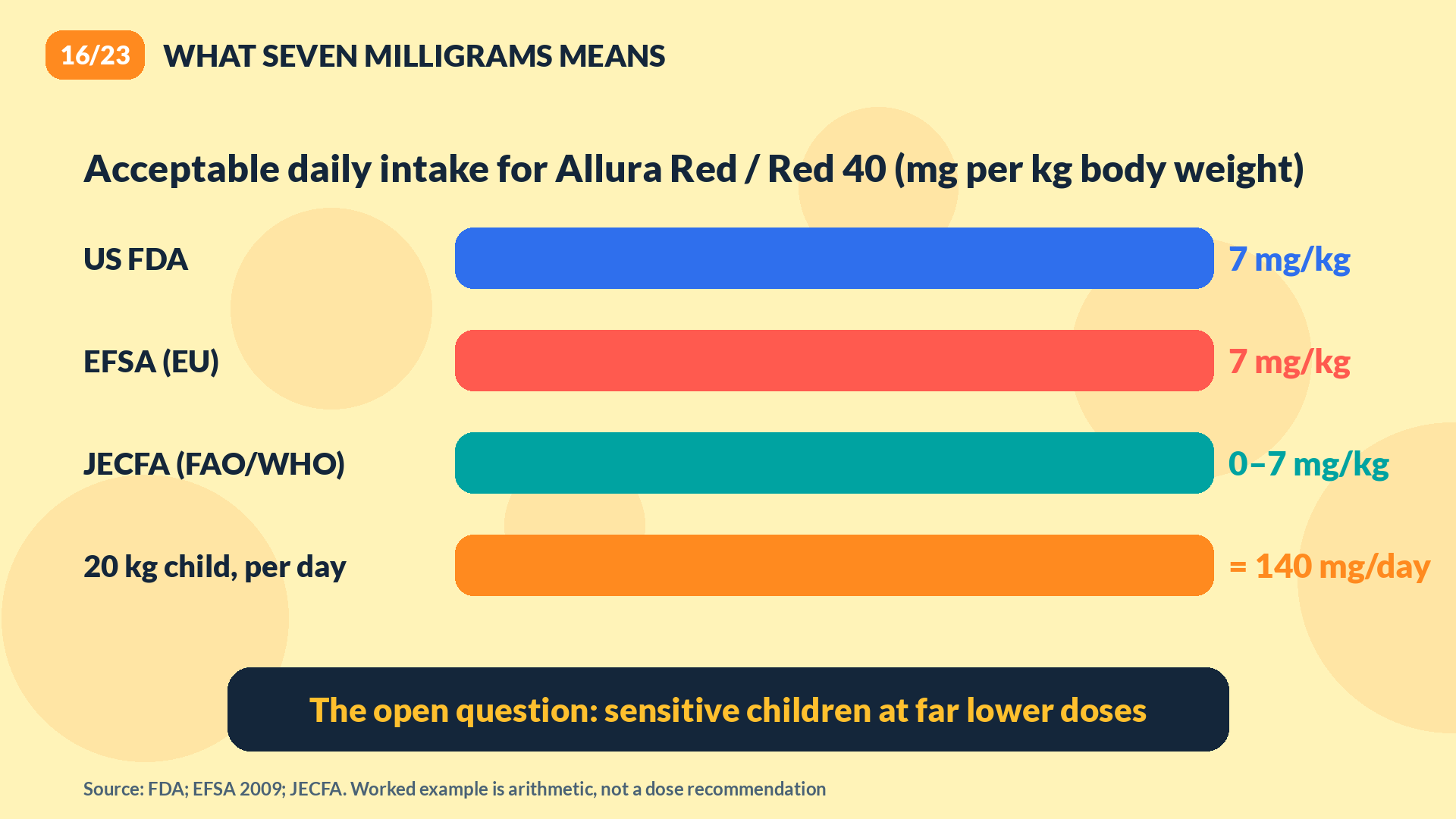
EFSA called the Southampton result limited evidence of a small effect, and in 2009 kept Allura Red’s acceptable daily intake (ADI) — a guideline ceiling, not a personal dose — at 7 mg per kg of body weight per day. EU lawmakers added the warning anyway. The science said “small and uncertain”; the politics said “tell parents”.
California’s Office of Environmental Health Hazard Assessment (OEHHA, April 2021) concluded that synthetic food dyes can affect behaviour in some children, that sensitivity varies, and that federal ADIs rest on studies 35–70 years old not designed to detect behavioural effects. Federal approval did not change.
How do you read the packet?
In the UK, look for the warning sentence, or the colour names and E numbers. In the US, look for “Red 40”, “Allura Red” or “Red 40 Lake”. A lake is a dye bound to a mineral so it doesn’t bleed — like paint mixed with chalk so it stays put. Since 5 February 2026, US products may claim “No artificial colors” if colours come only from natural sources.
What is the status today?
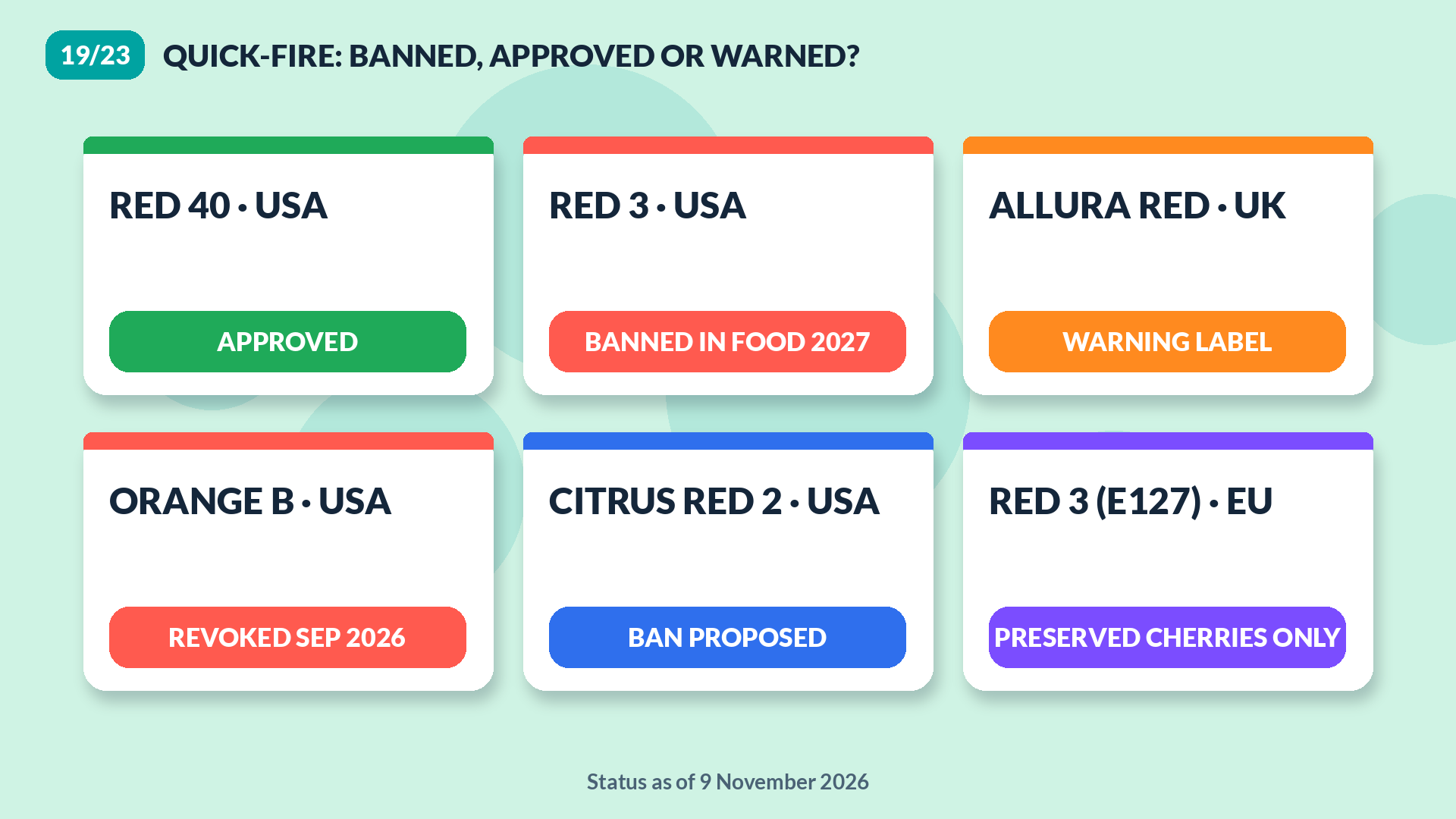
| Dye / place | Status |
|---|---|
| Red 40, USA | Approved (voluntary removal requested) |
| Red 3, USA | Banned in food from 15 Jan 2027 |
| Allura Red E129, UK/EU | Approved, with warning label |
| Orange B, USA | Revoked from 8 Sep 2026 |
| Citrus Red 2, USA | Ban proposed, not final |
| Red 3 (E127), EU | Only in certain preserved cherries |
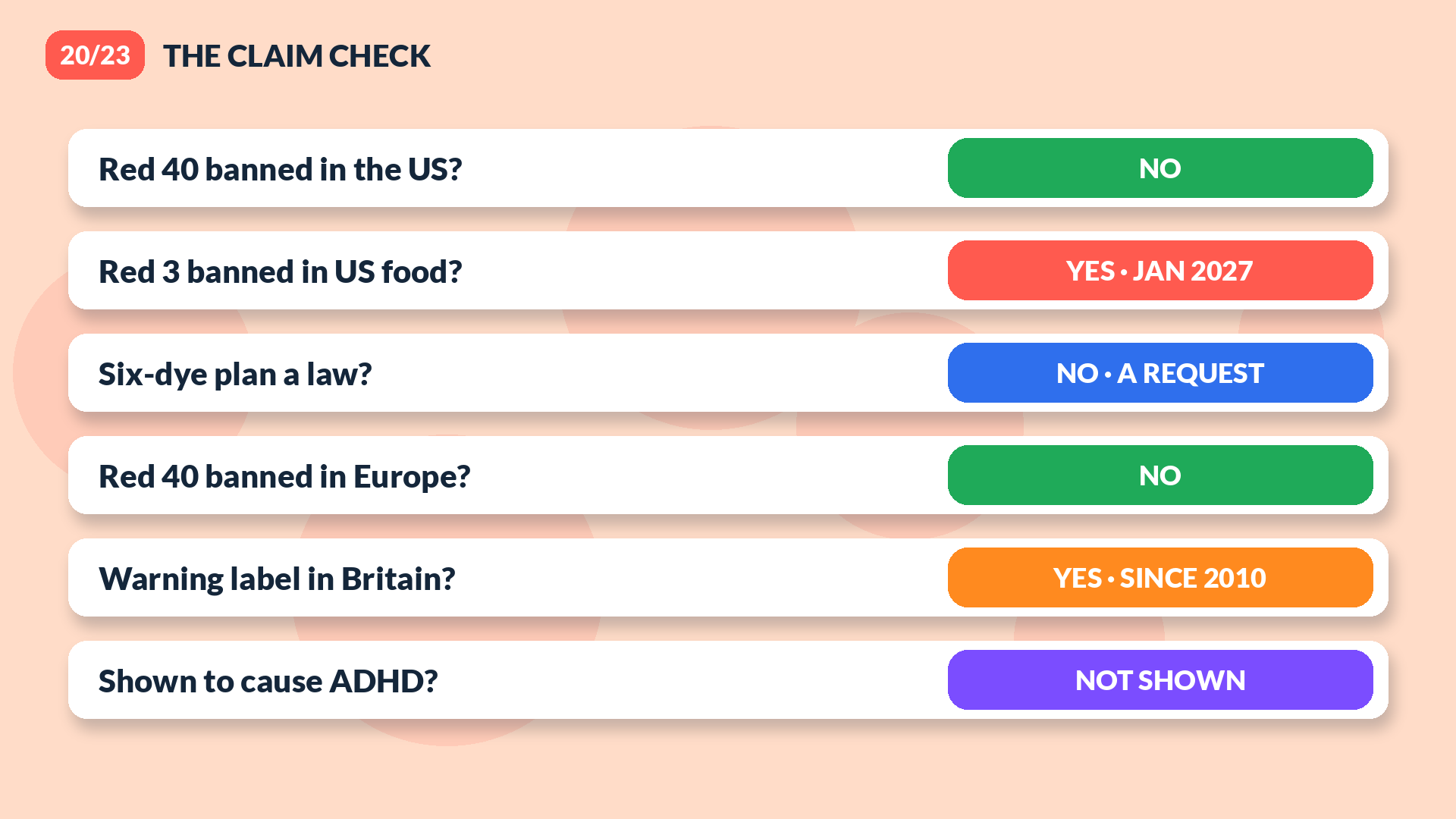
| Claim | Verdict |
|---|---|
| Red 40 is banned in the US | NO |
| Red 3 is banned in US food | YES, from Jan 2027 |
| The six-dye plan is a law | NO — a request |
| Red 40 is banned in Europe | NO |
| Britain requires a warning label | YES, since 2010 |
| Red 40 is shown to cause ADHD | NOT SHOWN |
On that last line: the Southampton trial measured hyperactivity scores after dye mixtures. It did not test, or show, that any dye causes ADHD.
How strong is the evidence?
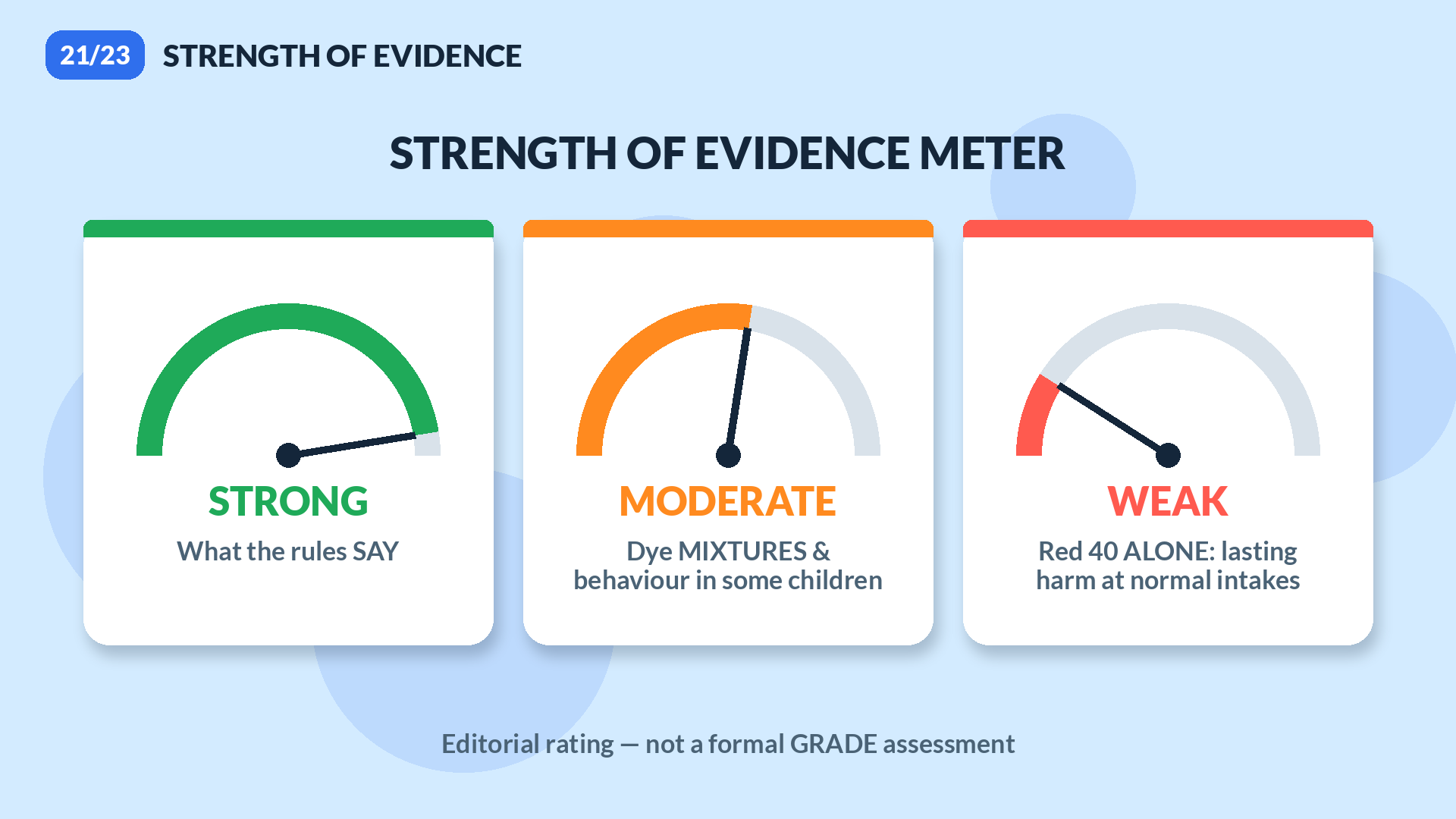
- What the rules say: STRONG — the official record.
- Dye mixtures nudge behaviour in some children: MODERATE — a real signal, small effects.
- Red 40 alone causes lasting harm at normal intakes: WEAK — not shown.
Editorial rating, not a formal GRADE assessment.
The verdict
Red 40 is not banned anywhere you are likely to shop. Red 3 is, in US food, from January 2027. Britain and Europe chose a warning label over a ban. If you want fewer synthetic dyes, read the ingredients, not the posts. This is public information explained, not medical or legal advice.
Questions from the label desk
Is Red 40 banned in the US?
No. Red 40 is still approved and listed at 21 CFR 74.340. In April 2025 HHS and the FDA asked industry to remove it and five other dyes, but a request has no legal force.
Is Red 40 banned in the UK or EU?
No. Red 40 is Allura Red AC (E129), approved in Britain and the EU. Foods containing it must carry the warning “may have an adverse effect on activity and attention in children”.
Which dye is actually banned in the US?
Red 3 (erythrosine) is revoked for food from 15 January 2027 and ingested drugs from 18 January 2028, under the Delaney Clause. BVO was revoked from August 2024 and Orange B from September 2026.
Does Red 40 cause ADHD?
That has not been shown. The Southampton study found small average increases in hyperactivity scores after dye mixtures with sodium benzoate; it did not test ADHD causation, and no effect could be pinned on one dye.
What is the acceptable daily intake for Allura Red?
FDA, EFSA and JECFA all use 7 mg per kg of body weight per day. EFSA’s refined exposure estimates put typical intakes below that.
Is this medical or legal advice?
No. It is public information explained. Read the primary sources below.
Primary sources and further reading
- FDA, Tracking food industry pledges to remove petroleum-based food dyes (content current 16 October 2026).
- Federal Register: 89 FR 55040; 90 FR 4628; 91 FR 50475; 91 FR 46276; 91 FR 46330.
- 21 CFR 74.340 — FD&C Red No. 40 (eCFR).
- H.R. 10936, Eliminating Dangerous Color Additives Act (29 October 2026) — mace.house.gov; Food Safety Magazine; thefutureoffood.org.
- Regulation (EC) No 1333/2008, Annex V — legislation.gov.uk.
- McCann D et al. Food additives and hyperactive behaviour in 3-year-old and 8/9-year-old children in the community. Lancet 2007;370:1560–67.
- EFSA ANS Panel (2009). Scientific opinion on the re-evaluation of Allura Red AC (E 129); EFSA (2015) refined exposure assessment for Allura Red AC.
- OEHHA (April 2021). Health effects assessment: potential neurobehavioral effects of synthetic food dyes in children.
- fooddyelaws.com — FDA food dye phase-out tracker (laws checked 1 November 2026).
Corrections welcome. Some FDA and EUR-Lex primary pages were not directly retrievable from our research machine on 9 November 2026; dates were cross-checked against two independent secondary sources. If you spot a discrepancy, tell us and we will correct this page.
Watch the film on YouTube (@PlateEvidence) · Subscribe for a weekly evidence file.